Total Solar Eclipse in Spain on 12 August 2026: A Route Along the Path of Totality
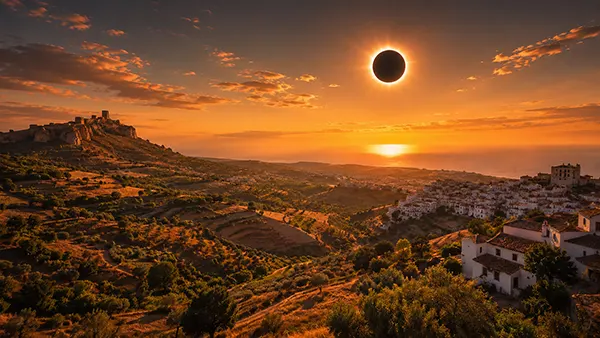
On Wednesday, 12 August 2026, a total solar eclipse will cross northern Spain from the Atlantic coast to the Balearic Islands. It will be the first total eclipse visible from mainland Spain in more than a century, but the conditions will differ greatly between regions. Totality will occur shortly before sunset, so a place located inside the eclipse band is not automatically a good viewing point: the western horizon must also be free of mountains, buildings, trees and coastal headlands. A journey along the eclipse path can connect Galicia, Asturias, Castile and León, Aragón and the Mediterranean coast, although travellers must choose one final observation site rather than attempt to follow the moving shadow by road. This route explains where the total phase will be visible, how the main regions compare and how to organise the day without turning the trip into an overly technical astronomy expedition.
Understanding the Spanish Path of Totality
The eclipse will reach Spain during its closing stages. The partial phase will begin in A Coruña at about 19:31 local summer time, while locations farther east will see it begin several minutes later. Totality will pass through parts of Galicia before covering Asturias, Cantabria, much of the Basque Country, La Rioja and broad areas of Castile and León. It will then continue across Aragón, southern sections of Catalonia, northern parts of Castilla-La Mancha, Castellón, northern Valencia and the Balearic Islands. Cities within or close to the totality band include A Coruña, Oviedo, León, Burgos, Bilbao, Logroño, Zaragoza, Teruel, Castellón de la Plana, Valencia and Palma. Madrid and Barcelona are not reliable alternatives for the full experience because most central and southern parts of Madrid and much of Barcelona will see a partial eclipse rather than complete coverage of the Sun.
The duration of totality will vary according to the observation point. A Coruña is expected to receive approximately 76 seconds of totality at around 20:28, with the Sun roughly 12 degrees above the horizon. Burgos will be closer to the central part of the band and is expected to receive about 104 seconds at around 20:29, although the Sun will be lower, at approximately eight degrees. In Palma, the maximum phase will occur close to 20:32 and the remaining partial phase will continue beyond local sunset. These differences create a practical compromise. Western Spain offers a slightly higher Sun and more time before sunset, whereas some inland locations offer a longer total phase and historically lower cloud frequencies. The longest possible duration should therefore not be the only factor used to select a viewing site.
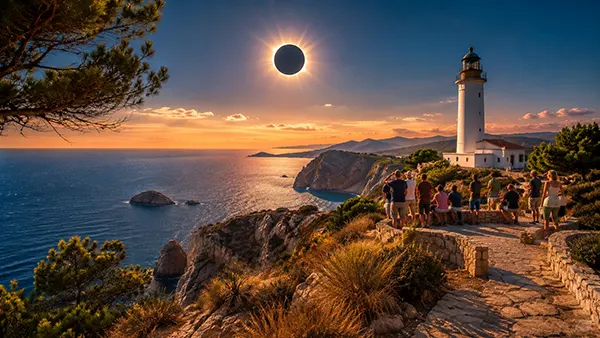
A position near the edge of the totality band may produce only a few seconds of complete darkness, even when a nearby town receives a considerably longer total phase. Travellers should use the official IGN municipal viewer to check the exact coordinates of a hotel, campsite or field rather than relying on a general regional map. A suitable site should lie comfortably within the band and provide an uninterrupted view towards the west or west-north-west. The low evening Sun is important because a distant ridge that appears harmless during the day may hide the final stages completely. The best approach is to inspect the intended location at the same time of day before 12 August, noting the direction of sunset, nearby vegetation, private boundaries, parking space and any narrow access roads that could become congested.
A West-to-East Journey from Galicia to the Mediterranean
A practical route can begin in A Coruña two or three days before the eclipse. The city lies inside the path of totality and offers straightforward air, rail and road connections, while the Atlantic coast provides several naturally open viewpoints. The western position is valuable because the Sun will remain higher above the horizon than it will in eastern Spain. However, the exposed coastline does not guarantee clear conditions. Sea mist and low Atlantic cloud are possible even during August, and some cliffs face the wrong direction or have headlands blocking the evening Sun. Travellers staying in A Coruña should identify both a coastal location and an inland alternative. The route can then continue through Lugo towards Asturias, using the journey to compare the greener Atlantic landscape with the broader horizons found farther south.
Oviedo, the Asturian coast, Santander and Bilbao all fall within the wider eclipse corridor, but the Cantabrian coast has the highest historical cloud frequency among the principal Spanish viewing regions. These destinations still make worthwhile stops during a longer holiday, particularly for travellers who value coastal scenery and local food, but they require a flexible weather plan. From Asturias or Cantabria, the route should turn inland towards León and Burgos. The landscape gradually changes from mountain valleys to the open plains of Castile and León, where it is generally easier to find a low western horizon. León can serve as a base for rural observation points, while Burgos combines city accommodation with quick access to open agricultural country. A traveller following the entire route should spend at least two nights in this inland section rather than treating it as a brief driving stop.
From Burgos, the route can continue through Soria and Zaragoza before reaching Teruel, Castellón or Valencia. This eastern section offers drier landscapes and, in many inland areas, better historical prospects for limited cloud. Zaragoza has extensive transport connections, but a city-centre position may be unsuitable because buildings can obstruct the low Sun. Smaller communities west and south-west of the city provide more open ground, subject to local access controls. After the eclipse, the journey may continue to Valencia or the Balearic Islands as part of the holiday. Attempting to watch totality in Aragón and then reach the Mediterranean phase is not realistic: the Moon’s shadow crosses Spain far faster than any car or train. The route should be completed before eclipse day, with 12 August reserved for one selected observation area.
Comparing Weather, Horizons and Travel Conditions
Cloud is the greatest uncertainty, and no reliable forecast can be produced weeks or months in advance. A 2026 AEMET study examined cloud conditions between 2010 and 2025 for 11–13 August during the hours corresponding to the eclipse. It found that the probability of clear or lightly clouded skies was generally lowest along the northern coast of Galicia, Asturias, Cantabria and the Basque Country, where the recorded frequency was approximately 30–50 per cent. Much of inland Castile and León, Castilla-La Mancha and the Ebro valley recorded frequencies closer to 50–70 per cent. These figures describe past conditions rather than the weather expected on 12 August 2026. They are useful for choosing a general base, but the final decision should be made using the latest AEMET forecast and satellite images during the days immediately before the event.
Weather statistics must be considered together with the height of the Sun. A Coruña has a less favourable historical cloud record than inland Aragón, yet the Sun will be several degrees higher during totality. Farther east, even a cloudless sky will not help if a mountain, apartment block or tree line covers the sunset direction. Wide plateaux, large agricultural areas and gently elevated viewpoints often provide better conditions than dramatic mountain summits. High altitude can offer a broader horizon, but mountain roads may be narrow, parking may be restricted and the Sun may still disappear behind a neighbouring ridge. Beaches also require careful checking: an east-facing beach or a bay enclosed by cliffs can have a poor western view despite its open appearance on a map.
August is one of Spain’s busiest travel months, and the eclipse is expected to add heavy local traffic during a narrow period. Accommodation close to recognised viewing areas may already be limited, particularly in small towns and rural districts. Staying within walking distance of an observation point is safer than planning a long afternoon drive. Where driving is necessary, visitors should arrive several hours before the partial phase and use designated parking rather than road verges, farm entrances or emergency access routes. A two-night stay covering 11 and 12 August reduces pressure to travel immediately before or after the eclipse. It also provides time to inspect the site, purchase supplies and respond to official instructions concerning temporary road restrictions, fire precautions or visitor capacity.
Strong Viewing Bases in Castile, Aragón and the Balearic Islands
Burgos is one of the most balanced bases for travellers who want a long total phase without travelling deep into remote country. The city is expected to receive about 104 seconds of totality, compared with approximately 76 seconds in A Coruña. Its main limitation is the low solar altitude, which makes an open western horizon essential. The surrounding plateau provides numerous broad landscapes, but observers must use public or authorised land and avoid blocking agricultural tracks. León offers another option, including elevated rural districts. Official tourism material has identified La Camperona near Sotillos de Sabero, at roughly 1,600 metres, as a notable observation area. Mountain locations of this type should only be considered when access, parking and crowd arrangements have been confirmed through local authorities.
Inland Aragón is particularly attractive for travellers prioritising historical cloud conditions and organised access. At the time of writing in July 2026, Épila has an official observation area with an expected total phase of approximately 92 seconds and a recorded historical cloud figure of 23 per cent. The published arrangements include capacity for 5,000 visitors and parking for 1,800 light vehicles. Access is scheduled to operate between 10 August and 13 August, but the area does not provide a normal campsite or facilities for disposing of grey and black water. Registration and current entry rules should be checked before travelling. Other authorised points in Aragón may provide different services, so visitors should compare parking, shade, drinking water, fire risk and walking distance instead of choosing solely by the number of seconds of totality.
The Valencian Community and the Balearic Islands offer a Mediterranean setting, but the very low Sun makes site selection more demanding. Castellón and northern Valencia are inside the totality band, while Alicante will experience a partial eclipse. In the Balearic Islands, totality will be visible from Mallorca, Menorca, Ibiza and Formentera under broadly similar astronomical conditions. The regional authorities expect high mobility and have asked visitors not to block rural roads, emergency routes or private property. August also brings a serious wildfire risk, so flames, cigarettes, fireworks and other possible ignition sources must be avoided. Observation from a boat introduces additional concerns, including congestion, navigation lights, lifejackets and safe distances between vessels. A land-based site with controlled access is generally the simpler choice for an unfamiliar visitor.
Preparing for Eclipse Day Safely
Certified solar viewers are required throughout every partial phase. Suitable products should be marked as complying with ISO 12312-2:2015 and should carry the required manufacturer information and an authentic CE mark when sold in the European Union. Ordinary sunglasses, smoked glass, photographic film, CDs and improvised dark materials do not provide safe protection. Glasses must be checked before use and discarded if the filter is scratched, punctured, loose or separated from the frame. Children should be shown how to keep the viewers in place before looking towards the Sun. People who normally wear prescription glasses can hold eclipse viewers over them, provided the solar filters remain flat and completely cover both eyes.
Binoculars, cameras and telescopes need purpose-made solar filters fixed securely over the front of the optics. Looking through an optical device while wearing eclipse glasses is unsafe because the concentrated sunlight can damage the filter and the eye. During the brief period of complete totality, when the solar disc is entirely covered, the corona can be viewed directly. Eye protection must be replaced before the first bright part of the Sun reappears. Anyone uncertain about the timing should follow the instructions of trained organisers and keep the viewers on. This is particularly important near the edge of the totality band, where complete coverage may last only a few seconds, and in locations where clouds make it difficult to judge the precise phase.
A useful day bag should contain eclipse viewers, drinking water, sun cream, a hat, suitable clothing, any necessary medication, a torch and a charged telephone or power bank. An offline map is valuable where mobile networks become overloaded. A folding chair may help during the long partial phase, but equipment should not obstruct paths or neighbouring observers. Visitors should take all waste away and avoid entering dry grass with a hot vehicle. No fire should be lit, even in places where picnics are normally permitted. Weather conditions can remain hot until late evening, yet temperatures may fall noticeably during totality and after sunset, especially on exposed plateaux or mountain viewpoints. A light additional layer is therefore sensible.
A Realistic Schedule for 12 August and the Perseid Night
The safest timetable begins early. Travellers using an organised observation area should follow its assigned arrival period, while those using another lawful public site should aim to be parked by early afternoon. The western horizon can then be checked in daylight, with cameras and chairs positioned well before the event begins. Across the main Spanish route, the partial phase will generally start between approximately 19:31 and 19:38, and totality will occur between about 20:28 and 20:32. Exact times depend on the coordinates. Setting up by 18:30 leaves a reasonable margin for delays and removes the temptation to adjust equipment at the critical moment. After totality, drivers should wait for pedestrian movement and local traffic to ease rather than leaving immediately with the largest part of the crowd.
Weather planning should remain flexible but controlled. During the week before the eclipse, travellers can compare several forecast models and official AEMET updates. Around 72 to 48 hours beforehand, the likely cloud pattern should be clear enough to decide between preselected alternatives in the same broad region. Any move should take place early on 12 August or, preferably, the previous day. Driving from the Cantabrian coast to Aragón during the afternoon in response to changing cloud is a poor strategy because roads may be busy and suitable parking may already be full. Two or three carefully researched backup points are more useful than a long list of improvised destinations. Each must be inside the totality band, legally accessible and open towards the western horizon.
The evening does not need to end when the eclipse finishes. The night of 12–13 August coincides with the expected maximum period of the Perseid meteor shower, and the new Moon associated with the eclipse will not brighten the sky. Travellers staying at a safe rural site may therefore remain after darkness falls, provided the location permits night access and vehicles are parked correctly. Meteors can be watched without telescopes by allowing the eyes time to adjust and looking across a broad section of sky. The combination of the eclipse and the Perseids makes an overnight stay more practical than an immediate drive back to a major city. The most reliable plan is simple: complete the west-to-east journey before 12 August, select one authorised site, arrive early, protect the eyes correctly and allow enough time for traffic to clear after nightfall.