Grand Egyptian Museum in Giza in 2026: What to See and How to Plan Your Visit
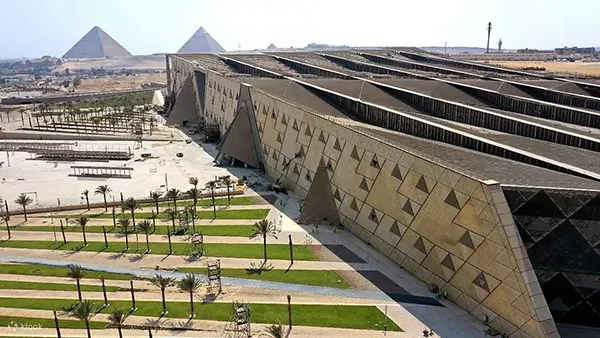
The Grand Egyptian Museum in Giza has moved beyond years of previews and partial openings: in 2026 it operates as a fully opened museum and has become one of the most important additions to a Cairo itinerary. Officially inaugurated on 1 November 2025 and opened fully to the public a few days later, the museum stands near the Giza Pyramids at El Remayah Square and brings together more than 100,000 ancient Egyptian objects covering thousands of years of history. Its scale is considerable, but visitors do not need specialist knowledge of Egyptology to make sense of it. The building has been arranged so that monumental statues, royal objects, burial equipment and items from everyday life gradually build a broader picture of ancient Egypt. The complete Tutankhamun collection is the major attraction, but it is only one part of a visit that can also include the Grand Hall, Grand Stairs, twelve Main Galleries, the Hanging Obelisk and the Khufu’s Boats Museum. Because there is far more to see than most people can comfortably cover in a short stop, planning the order of the visit matters almost as much as booking the ticket itself.
What to See at the Grand Egyptian Museum in 2026
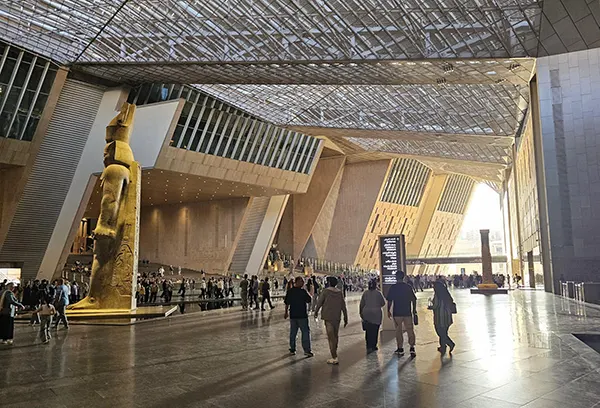
A sensible first impression of the museum begins before the main galleries. Visitors approach the building through a monumental setting designed to connect the modern museum visually with the nearby pyramids. One of the first major pieces is the Hanging Obelisk, displayed so that its base can also be seen rather than disappearing into a conventional stone support. Inside the Grand Hall, attention immediately moves to the colossal statue of Ramesses II. The statue has a particularly important place in the museum’s history because it was transferred from central Cairo and installed at GEM years before the complete museum opened. The Grand Hall is therefore not simply an entrance lobby. It introduces the scale of royal sculpture and provides a natural starting point before visitors move deeper into the collection. The museum complex covers about 500,000 square metres overall, so it is worth resisting the urge to walk quickly towards Tutankhamun. Spending some time in the entrance areas makes the later galleries easier to understand and prevents the visit from becoming a race between famous objects.
The twelve Main Galleries provide the broad historical framework. Their displays span ancient Egyptian history from its earliest periods through the Graeco-Roman era, while the arrangement also follows themes such as society, kingship and religious belief. This makes the galleries useful for visitors who know the names of famous pharaohs but are less familiar with how ordinary Egyptians lived, worked, worshipped or prepared for death. Statues and royal objects remain important, but they sit alongside material connected with families, craftsmen, administration, temples and burial traditions. Rather than treating several thousand years as one continuous and unchanging culture, the galleries show that political power, artistic styles, religious ideas and daily practices developed repeatedly over time. Visitors with limited hours do not have to stop at every case. A better approach is to follow the chronological sequence, choose a few objects in each section and read the interpretation around them. This gives enough context to understand later highlights without turning the first half of the visit into an exhausting exercise in reading every label.
The Grand Stairs form the transition between the monumental entrance and the principal exhibition areas. The route contains 59 major artefacts and architectural elements arranged around themes connected with royal power, temples, relationships between kings and deities, and beliefs surrounding death and eternity. The setting is deliberately spacious, allowing colossal pieces to be seen from several levels instead of being compressed into ordinary gallery rooms. It is also one of the places where the museum’s position close to the Giza Pyramids becomes part of the visit itself, with views towards the ancient landscape from within the modern building. The staircase should not be treated simply as a way of reaching another floor. Allowing twenty or thirty minutes here gives enough time to appreciate the larger sculptures without disrupting the rest of the schedule. For anyone visiting GEM for the first time, a practical sequence is the Hanging Obelisk, Grand Hall and Grand Stairs first, followed by the Main Galleries and then the more concentrated Tutankhamun and Khufu displays.
Tutankhamun, Ramesses II and the Khufu Boats
The Tutankhamun Galleries are the section many visitors will have planned the entire trip around. In 2026, the significance of these rooms is very different from the smaller selections historically shown elsewhere in Egypt. The Grand Egyptian Museum brings together the complete group of objects recovered from Tutankhamun’s tomb, with Egyptian authorities giving the total as 5,398 pieces. For the first time, the collection can be viewed together rather than as a mixture of famous display pieces and thousands of objects kept in storage or separate locations. The presentation covers more than gold alone. Visitors see material connected with the king’s identity and family, objects used during his lifetime, furniture, jewellery, ceremonial equipment and the complex group of items prepared for his burial and afterlife. The famous golden burial mask is naturally one of the focal points, but the value of allowing substantial time here is that smaller possessions place the spectacular royal objects into context. They make Tutankhamun easier to understand as a young ruler whose tomb preserved an unusually complete group of possessions.
The galleries organise Tutankhamun’s story around several connected themes: the discovery of the tomb, the king’s identity, his lifestyle, his funeral and the concept of rebirth after death. This is useful for visitors who would otherwise move from one golden object to another without understanding why they were placed in the burial. Coffins and shrines can be considered alongside furniture, personal possessions and ritual items rather than as isolated masterpieces. The arrangement also helps explain why the 1922 excavation led by Howard Carter became such an important event in archaeology. Most royal tombs in the Valley of the Kings had been robbed extensively in antiquity, whereas Tutankhamun’s burial preserved an exceptional quantity of material. The result is not simply a collection associated with a famous name. It is a rare record of how an Eighteenth Dynasty royal burial was equipped. Even visitors who normally move quickly through museums should consider reserving at least an hour for these galleries, and substantially longer if Tutankhamun is the main reason for coming to GEM.
Another essential section is the Khufu’s Boats Museum. Two royal boats were found in pits beside the Great Pyramid in 1954, linking the museum directly with the archaeological landscape only a short distance away. One of these ancient boats has been reconstructed, while work connected with the second boat allows the site to address conservation as well as the finished object. The exhibition explains construction, the boats’ relationship with King Khufu and the different interpretations of their role in royal ritual, transport and the funerary complex. Seeing the vessel after visiting the Giza Plateau can be particularly effective because the geographical connection is immediately understandable: the boat was not collected from a distant part of Egypt but belonged to the same pyramid complex visible outside the museum. Together, the Khufu display, Tutankhamun collection and colossal statue of Ramesses II also prevent a GEM visit from focusing on a single period. Khufu belongs to the Old Kingdom, Tutankhamun to the New Kingdom, and Ramesses II ruled later in the New Kingdom, giving visitors several distinct points in Egyptian history to compare.
Tickets, Opening Hours and Entry Rules
Ticket arrangements in 2026 are straightforward but should be dealt with before arriving. GEM requires advance online booking with a selected entry time, and the museum advises visitors to use its official ticketing website. At the time of writing in August 2026, standard admission for visitors classified as Arabs or other nationalities costs EGP 1,590 for an adult and EGP 800 for a child or student. The listed expatriate rate is EGP 800 for adults and EGP 400 for children or students, while Egyptian admission is EGP 200 for adults and EGP 100 for children, students and seniors in the applicable categories. Children under six and several other eligible groups receive free admission, with identification required where an exemption or reduced rate applies. Prices can be changed by the museum, so the amount shown during the official booking process should be treated as the final figure for a particular visit. Booking early is especially sensible for weekends, holidays and popular morning times because online capacity can be reached.
On Sunday, Monday, Tuesday, Thursday and Friday, the wider GEM complex currently operates from 8:30 am until 7:00 pm, while the galleries are open from 9:00 am until 6:00 pm. The last entry is one hour before the galleries close. Wednesday and Saturday have substantially longer evening hours: the complex remains open from 8:30 am until 10:00 pm and the galleries from 9:00 am until 9:00 pm, with last entry at 8:00 pm. These extended days are particularly useful for travellers who want to combine the museum with the Giza Pyramids without rushing either attraction. The time printed on an admission booking is the period in which the visitor must enter; it does not mean everyone has to leave after a fixed two-hour or three-hour session. Once inside, visitors can remain within the permitted operating hours. Anyone whose priority is photography, detailed labels or the full Tutankhamun display will benefit from an early entry or one of the extended opening days rather than a late afternoon slot on a standard day.
Several entry conditions are worth knowing before leaving the hotel. Tickets are issued for the selected date and time, are non-transferable and are normally non-refundable, while each ticket permits a single entry rather than repeated exits and returns. Small bags are acceptable, but large bags, backpacks, luggage or parcels exceeding 40 by 40 centimetres must be stored in designated areas; free lockers are available. Personal photography and video are generally permitted, although restrictions apply in parts of the Tutankhamun Galleries, where camera use is more limited and mobile photography may be the only option in restricted areas. Flash, tripods, monopods, selfie sticks, drones, external lighting and live streaming are prohibited. Food cannot be taken into the galleries, although a small bottle of water is permitted. These rules are not unusual for a museum holding fragile archaeological material, but knowing them in advance prevents delays at security and makes it easier to travel with only what is actually needed for several hours indoors.
How Much Time to Allow and What to Bring
There is no single ideal visit length, but two hours should be regarded as a focused introduction rather than enough time to see everything. The museum’s standard guided tour itself lasts approximately two hours and covers major areas including the Grand Hall, Grand Stairs, Main Galleries and Tutankhamun Galleries. Independent visitors who want to see these sections at a comfortable pace should allow around four hours, while five to six hours is more realistic for anyone who intends to spend significant time with Tutankhamun, visit the Khufu’s Boats Museum, pause for food and look through the Main Galleries without constant time pressure. Trying to see every object is not a useful goal when the collection is this large. A better plan is to decide before entering which two or three areas matter most. First-time visitors might make Tutankhamun, the Grand Stairs and Khufu’s Boats their priorities, then use the remaining time for selected Main Galleries. Returning visitors can reverse that emphasis and spend more time on chronological and social history.
Comfortable footwear is more useful here than elaborate travel equipment. The building is large, and even a selective visit involves substantial walking and standing. Bring the identification required for any student, age-based or other reduced admission category, keep the digital ticket accessible on your phone and carry a small water bottle rather than food. A charged phone is useful for tickets, photography and navigation, and a compact power bank can be practical during a full day in Giza. Large luggage is best left at accommodation even though storage facilities exist, particularly because moving through security with unnecessary bags adds time at both arrival and departure. Visitors interested in photography should remember that bringing a tripod or selfie stick creates a problem rather than an advantage because such equipment is prohibited. The museum has cafés and restaurants, so there is little reason to pack a meal. This also makes a longer visit easier: a planned break halfway through the day can prevent the final galleries from becoming something visitors merely walk through while tired.
GEM has also been designed with accessibility in mind. The museum provides ramps, lifts, wide routes, accessible toilets, seating, wheelchairs and assistance for visitors who need additional support, while golf carts can help with movement in appropriate parts of the complex. Tactile material and Braille-supported elements are also part of the accessibility provision. Families have options beyond the principal archaeological galleries. The GEM Children’s Museum uses interactive and hands-on activities for younger visitors and, according to the current schedule, operates from 1:00 pm to 5:00 pm Sunday to Thursday and from 10:00 am to 5:00 pm on Friday and Saturday. Parents planning a family visit should therefore check the children’s schedule separately rather than assuming it follows the same hours as the main museum. Rest areas, accessible toilets, cafés, restaurants, prayer rooms, charging points, a clinic and an information desk are available within the complex, making it practical to structure the day around breaks rather than trying to complete several hours of galleries without stopping.
Getting to GEM and Planning a Giza Day
The Grand Egyptian Museum is located at El Remayah Square on the Cairo-Alexandria Desert Road, close to the Giza pyramid complex but outside central Cairo. For most international visitors, a taxi, hired car, organised transfer or tour bus remains the simplest way to reach it. The museum’s own visitor information provides road directions and confirms access by car, bus and public transport, but detailed public-transport guidance is still less complete than the information available for road access. Travellers should therefore avoid building a tight itinerary around an assumed direct metro journey to the museum. A car journey offers more predictable door-to-door logistics, although Cairo and Giza traffic can change considerably according to the time of day. On-site parking is available for a fee, but spaces can be limited during busy periods. When arranging a taxi or car, use the exact Grand Egyptian Museum destination rather than simply asking for the pyramids, as entrances to the two attractions are separate and the surrounding road network covers a large area.
Visitors staying in central Cairo should allow a generous traffic margin before the ticketed entry time. The safest approach is to work backwards from the booking rather than relying on a fixed driving estimate, because a journey that is straightforward during a quieter part of the day can take much longer in heavy traffic. Arriving a little early is preferable to reaching the entrance near the end of the allocated entry window. If GEM is the only major attraction planned for the day, a 9:00 am gallery entry gives the greatest flexibility. Starting early means the Grand Hall and Grand Stairs can be seen before the day is well advanced, while the afternoon remains available for the larger galleries and a break. Wednesday or Saturday is a useful alternative for travellers who prefer a slower start, as the galleries remain open until 9:00 pm. Evening access can also help people arriving in Giza after another sightseeing stop, provided they have reserved the appropriate admission time in advance.
Weather is another reason to think about GEM as part of a wider Giza plan rather than as an isolated attraction. Most of the principal museum experience is indoors, whereas the pyramids, Sphinx and surrounding plateau require much more time outside. During hotter periods, placing outdoor sightseeing earlier in the day and moving indoors afterwards is usually more comfortable. The official archaeological information for the Giza Plateau currently lists general site hours of 8:00 am to 4:00 pm, although individual monuments within the area can have their own schedules and access rules. This makes an early pyramid visit followed by an afternoon at GEM one of the most practical combinations. It also creates a logical historical link: visitors can see Khufu’s pyramid and its surrounding landscape first, then later view the royal boat associated with his complex inside the museum. Anyone who dislikes long sightseeing days should separate the two sites instead. GEM contains enough material to justify a dedicated day, particularly when Tutankhamun and the Main Galleries are both priorities.
Combining the Museum with the Pyramids
A full Giza day works best when it is treated as two substantial visits rather than one attraction followed by a quick museum stop. One workable schedule is to reach the Giza Plateau around opening time, spend the morning at the pyramids and Sphinx, take a proper break for lunch, then enter GEM in the early afternoon. On a Wednesday or Saturday, the extended museum hours make this especially comfortable because there is no need to compress the indoor visit into the period before 6:00 pm. On other days, aim to reach GEM early enough to have at least four hours before the galleries close. Travellers who want to enter the Great Pyramid itself should allow additional time on the plateau rather than simply adding the interior visit to an already crowded schedule. Heat, walking distances and security checks can all make the outdoor portion of the day slower than expected. Booking GEM for the afternoon therefore requires a realistic buffer between leaving the pyramid area and the museum’s timed entrance.
The Giza Plateau and Grand Egyptian Museum use separate admission systems, so a museum ticket does not cover the pyramids or entry inside individual monuments. At the time of checking in 2026, the official Egyptian monuments service lists general Giza Plateau admission for foreign adults at EGP 700 and students at EGP 350. Entry to the interior of the Great Pyramid requires a separate ticket in addition to the area admission; the currently listed foreign adult price for the Great Pyramid itself is EGP 1,000. These figures are useful for budgeting, but archaeological-site prices and access conditions can change, so they should be checked again shortly before the visit. Visitors who are mainly interested in seeing the pyramids from outside do not need to purchase every supplementary monument ticket. Choosing one or two paid interior attractions leaves more time and energy for GEM later. The same principle applies inside the museum: a successful day is based on priorities rather than trying to complete every available activity simply because it is nearby.
For most first-time visitors in 2026, the best overall plan is therefore simple: reserve GEM online before the trip, select a realistic timed entry, decide whether the pyramids will be visited on the same day, and identify the museum sections that matter most before arriving. Tutankhamun deserves substantial time, but the Grand Hall, Grand Stairs, Main Galleries and Khufu’s Boats Museum provide the historical range that makes GEM more than a home for one famous royal collection. If the museum and pyramids are combined, start the outdoor section early and use the museum for the second half of the day, preferably on Wednesday or Saturday if extra evening time would be useful. If GEM is given its own day, arrive when the galleries open and allow at least four hours, with five or six providing a much less rushed visit. Ticket prices, opening hours and individual access arrangements should always be checked shortly before travel because they can be revised, but the museum’s full opening means travellers in 2026 can now plan around a complete collection rather than the limited-access arrangements that applied during earlier preview years.