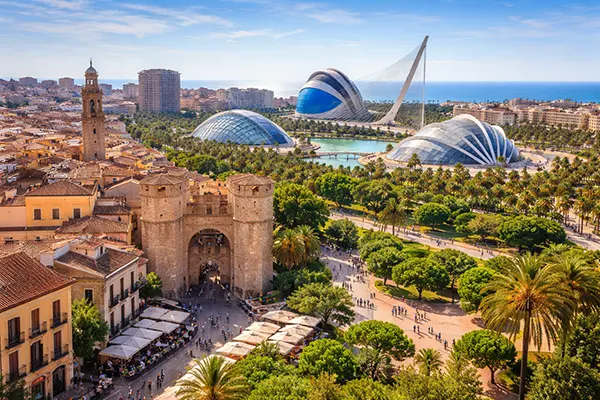
Valencia 2026: a city where the future sits beside the old world — from the Ciutat de les Arts i les Ciències to El Carmen
Valencia is one of the rare European cities where medieval streets, baroque façades and cutting-edge architecture feel like part of the same story. In 2026 you can spend the morning in the historic centre, then cross the former riverbed of the Turia to reach the white, sculptural skyline of the Ciutat de les Arts i les Ciències — without it feeling like a hard “before/after” switch. This guide focuses on two clear routes (historic and modern), plus practical planning for a smooth day at the City of Arts and Sciences, beaches that still feel like a local habit, and food that goes beyond clichés.
Route 1: Historic Valencia — El Carmen, stone lanes, and the city’s quieter masterpieces
Start early in the old town, when the streets are still calm and the light makes the stonework look almost golden. The historic route works best on foot: it’s compact, and the best moments are often small ones — a tiled sign, a hidden courtyard, a church façade you nearly miss because you were looking at the balconies above. El Carmen is the heart of this walk: it’s a lived-in neighbourhood, not an “open-air museum”, so expect a mix of galleries, everyday shops, and street art beside centuries-old walls.
A simple way to structure the morning is: Plaza de la Virgen → Cathedral area → La Lonja neighbourhood → El Carmen. The Cathedral zone is your architectural timeline in one place: Roman foundations, Gothic structure, later additions, and a city that kept building without erasing what came before. Then head towards the La Lonja area (one of the most atmospheric parts of central Valencia) and continue into El Carmen, where narrow streets keep opening into small squares with cafés and local bars.
To avoid “church-and-monument fatigue”, add one or two indoor stops with a different rhythm: a small museum, a ceramics collection, or simply a long coffee in a shaded plaza. Valencia’s historic centre rewards slow pacing — if you try to tick everything off quickly, it becomes noise. Keep one goal for the morning (for example: “El Carmen and La Lonja”) and let the rest be discovery.
How to walk El Carmen without getting lost (and why that’s a good thing)
El Carmen is designed to make you turn corners. Instead of fighting it, choose a few anchor points and let the routes between them be flexible. Good anchors include Torres de Serranos, the area around Plaza del Tossal, and the streets closer to the old riverbed. If you drift, the neighbourhood still funnels you back towards something recognisable — and that’s part of its charm.
For photographs and atmosphere, late morning works well: the shops open, the streets feel alive, and you can stop for something small to eat without it becoming a full sit-down lunch. If you’re travelling in peak season, it’s smart to schedule your “proper lunch” slightly later than typical Spanish time — you’ll avoid the busiest moment and get better service.
When you’re ready to switch from “old Valencia” to “modern Valencia”, the easiest transition is the Turia Gardens. They act like a green corridor between worlds: you leave the dense historic centre, step into a broad park, and walk or cycle towards the City of Arts and Sciences without needing a car.
Route 2: Modern Valencia — the Turia Gardens and the Ciutat de les Arts i les Ciències
The modern route is best approached as a sequence: Turia Gardens → architecture viewpoints → one or two major venues inside the City of Arts and Sciences. The complex is famous for its design, but it’s also a working visitor area with timed entries, queues, and a lot of ground to cover. In 2026, planning is what turns it into a relaxed day rather than a rushed sprint.
Ticketing matters. A commonly used option is the combined entry for Oceanogràfic, the Science Museum and Hemisfèric. Booking ahead is strongly recommended, especially when you want a specific Hemisfèric show time, because sessions can sell out in high season. If you have only one day, the best approach is to pre-select your main venue and avoid trying to do “everything” at maximum speed.
Even if you don’t go inside every building, the outdoor experience is worthwhile: the curves, bridges, and reflective water create constant new angles. Give yourself time for the “in-between spaces”, because they’re part of why the area feels so distinctive compared with other European cities that have modern districts separated from their historic core.
How to organise a full day at the City of Arts and Sciences without chaos
A calm plan starts with one fixed time: the Hemisfèric session. Build the day around it, not the other way round. The reason is simple: it has scheduled entry, while Oceanogràfic and the Science Museum are more flexible. If you lock in Hemisfèric mid-morning or early afternoon, the rest of the day falls into place naturally.
Then choose your “main venue” for the longest stretch. For many travellers that’s Oceanogràfic, because it is vast and easy to underestimate. You can comfortably spend several hours moving between its sections without rushing, and it is the type of place where breaks matter — especially when visiting with children or during warm weather.
Finally, plan a real pause. The complex has plenty of visual intensity, and if you keep moving non-stop you’ll be tired before you’ve properly enjoyed it. A good rhythm is: Hemisfèric → lunch or long break → Oceanogràfic → slow walk around the exterior at sunset. In winter and early spring, the evening light can be spectacular on the white surfaces — and the area feels less crowded.
Beaches, food, and practical 2026 logistics — the details that make the trip work
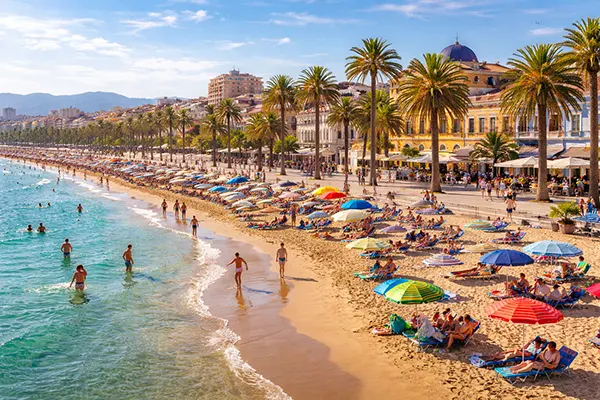
Valencia’s beaches aren’t an “extra”; they’re part of the city’s weekly routine. Malvarrosa is the classic urban option, with wide sand, straightforward access, and a promenade where locals still come for evening walks. Patacona sits just north (technically in Alboraya) and often feels slightly calmer, with a strong café culture along the seafront. Both are easy choices when you want a reset after a museum-heavy day.
In 2026, the practical advantage of Valencia’s coastline is that it is well organised: you can rely on facilities, clear access points, and a city rhythm that still treats the beach as a normal part of life rather than a purely tourist space. If you prefer quieter nature, the Albufera area south of the city offers a different kind of coastal day — more wetlands and open horizons than urban promenade.
Food deserves the same realism. Paella is essential, but it’s not the only story. Markets are where Valencia feels most honest: seasonal citrus, local vegetables, cured meats, and seafood counters that show what is actually in demand that week. If you want rice beyond the standard tourist menu, look for seasonal variations and ask what locals are ordering. A simple rule still holds: eat paella for lunch, not dinner — that is the local pattern, and you will usually get a better experience.
Getting around in 2026: transport, cycling, and the Valencia Tourist Card as an option
Valencia is easy to manage without a car. The historic centre is walkable, the Turia Gardens are ideal for cycling, and the metro and tram network connects the key zones. If you like having a predictable plan, the city works well in “district blocks”: old town in the morning, Turia route at midday, beach or seafront in the evening.
The Valencia Tourist Card can make sense when you plan to use public transport frequently and want to combine museums, attractions, and consistent movement across the city. The value depends on your rhythm: if you stay two or three days and use transport daily, it can simplify the logistics and reduce the need for separate tickets.
For cycling, the Turia Gardens are the easiest spine through the city: flat, scenic, and separated from traffic for long stretches. It is one of the best ways to connect the old centre to the modern architecture without feeling like you are commuting. Combine that with an evening at Malvarrosa or Patacona, and the day ends with a completely different Valencia — still the same city, just a different mood.